The Cognitive Benefits of the Sketchbook: Why Volume Matters More Than Perfection
The Cognitive Benefits of the Sketchbook: Why Volume Matters More Than Perfection

Click to watch (8:54) or scroll down to read
The Cognitive Benefits of the Sketchbook: Why Volume Matters More Than Perfection
Dear Art Friends,
Has this ever happened to you?
As artists, we often fall into a common trap: the paralyzing belief that every time we sit down to draw, we must produce a finished, portfolio-ready masterpiece. This mindset is the enemy of growth. It induces performance anxiety and stifles experimentation.
True artistic development doesn't happen in the final hours of rendering a polished piece; it happens in the messy, rapid, iterative environment of the sketchbook.
In cognitive science regarding skill acquisition, there is a concept known as "deliberate practice." It is not enough to just draw; one must draw with intention, pushing past comfort zones and receiving immediate feedback (even self-feedback).
Recently, I conducted a two-and-a-half-hour digital sketchbook session focused solely on volume and variety. The goal was not to create seven perfect dog portraits, but to force my brain to quickly analyze and translate complex forms into intelligible sketches.
The Case Study: Seven Dogs in 150 Minutes
Below is the result of that session. The subjects ranged from young puppies to adult dogs, squashed-faced Pugs to long-snouted Collies, and static poses to dynamic movement.
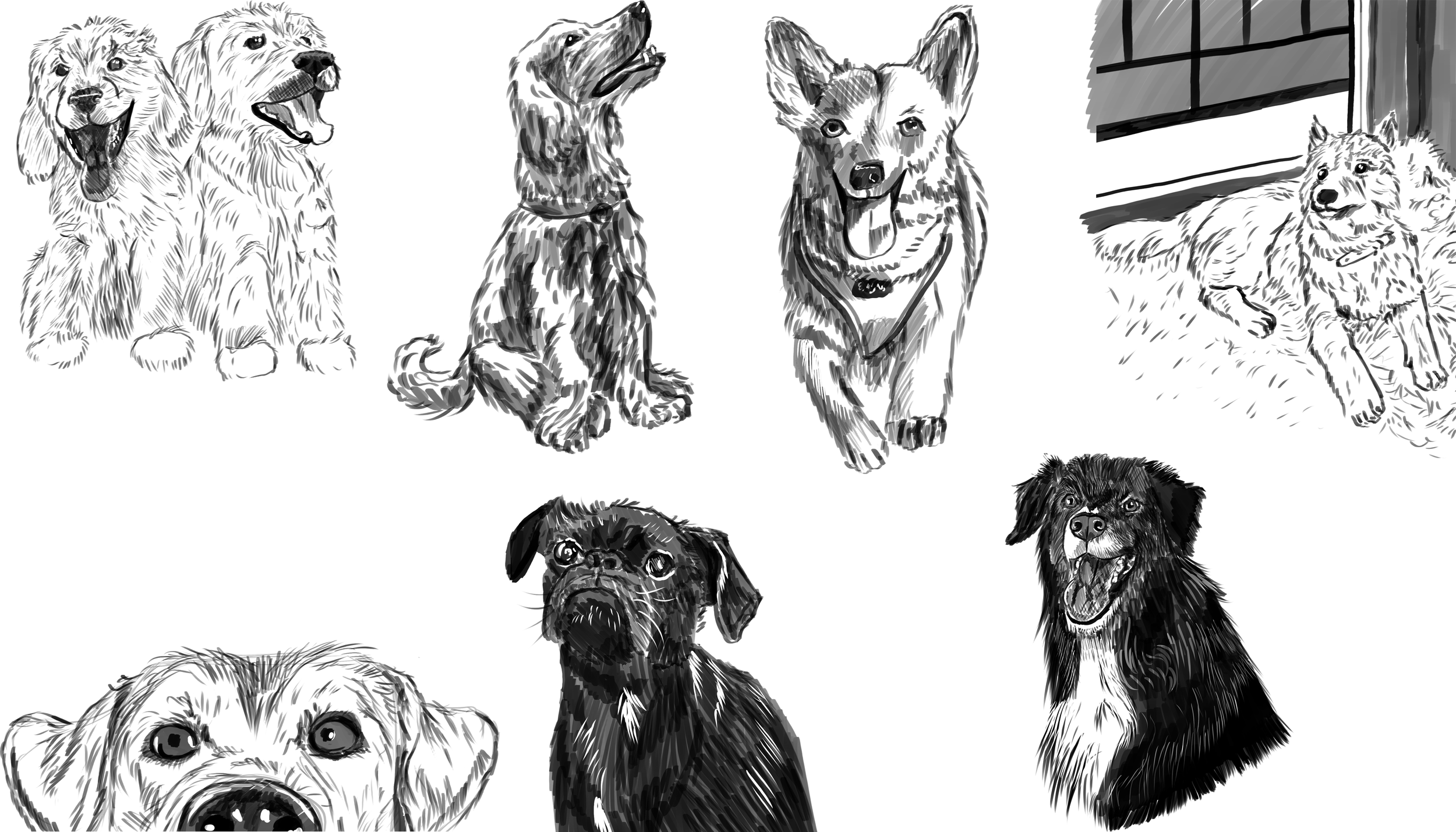
A digital sketchbook spread featuring seven different breeds, focusing on varied angles and expressions. Total drawing time: 2 hours, 33 minutes.
Why is this type of session so valuable compared to spending the same amount of time on one drawing?
1. The Philosophy of Volume: Repetition and "Muscle Memory"
“I fear not the man who has practiced 10,000 kicks one time, but I fear one who has practiced one kick 10,000 times”
-Bruce Lee
There is a distinct difference between "practicing" and "performing." A polished piece is a performance. A sketchbook page is practice.
When you commit to speed-drawing multiple subjects, you force your brain to bypass the preciousness of details and focus on the big picture: gesture, proportion, and primary shapes. You are training your eye to see relationships and the essence of a subject faster.
In this instance, by drawing seven dogs instead of one, I had to make thousands of micro-decisions about form and line weight in a compressed timeframe. This high volume of decision-making is what builds intuitive "muscle memory" (or more accurately, “cognitive shorthand”) better than laboring over a single piece of fur for an hour.
Doing a thing (like drawing) only once gives you a surface view. Doing it repeatedly ingrains the information so you can pull it up without hesitation.
The importance is work for improvement - not working for perfection.
2. Building a "Mental Library" Through Variety
Think back to when you learned to drive. In the beginning, you had to consciously think about everything: Check the mirror. How much pressure on the gas? Is that car merging? It was exhausting.
But after thousands of miles, you built a mental library of road scenarios. Now, you can drive a car, a truck, or even back a trailer because you understand the core physics of driving. You don’t have to relearn how to turn the wheel every time you get in a new vehicle.
Art is the same.
If you only ever draw Labrador Retrievers from a side profile, you haven't learned to draw dogs; you have memorized how to draw one shape. To truly understand animal anatomy, you must stress-test your knowledge against variety.
This session included:
Structure: For example - the cranial difference between a Pug (brachycephalic) and a Collie (dolichocephalic).
Texture: The challenge of implying fluffy Golden Retriever fur versus the sleek, short coat of a Beagle.
Angles: Including the extreme foreshortening of a Corgi walking toward the viewer versus a static, seated Spaniel.
Every new angle and breed adds a new volume to your "mental library." When you understand how joints move and hair flows, learning a new breed isn’t “starting over” - it’s just applying your core knowledge to a new scenario. Also, the more varied shapes you have stored in that library, the easier it becomes to draw anything from imagination later without needing a direct reference.
3. The Medium is Irrelevant (Digital vs. Traditional)
While this session was recorded digitally, the principles of deliberate practice are agnostic to the medium.
Whether you are using an iPad Pro or a cheap ballpoint pen on printer paper, the cognitive load is the same.
The most important tool is not the brush - it is the grace to make mistakes. You must have the self-awareness to critique your work constructively. This allows you to improve without needing a teacher over your shoulder.
The Self-Critique: Ranking the “Success Ladder”
A sketchbook is not a gallery; it is a gymnasium for your artistic muscles. To show you what I mean, let’s critique my own session. I have ranked these sketches from “Least Successful” to Most Successful” and explained why below.
7. The Shiba Inu (The “Weakest Link”) I got a bit “lost in the sauce” trying to get the background right when I should have focused on the subject. The result relies too much on outlines rather than form. This was late in the session, and I was probably distracted by life (the dog, the phone, the husband).
Lesson: Don’t let background elements steal time from the main subject.
6. The Cocker Spaniel I captured the silhouette and the twist of the body, but the textures fell flat. There were four distinct materials here - fur, curls, webbed collar, metal tag - but they all look a bit “same-y.”
Lesson: Use brush pressure and marking variations to differentiate materials more clearly
5. The Golden Retriever Duo These were the first warm-up sketches, and it shows. They are a bit stiff, the negative space between them isn’t quite right, and the noses and mouths look pasted on rather than part of the muzzle and larger dog.
Lesson: The first sketch of the day is rarely the best. That’s why we do warm-ups!
4. The Border Collie Now we are climbing the ladder. I successfully used value to describe the different fur lengths, the mouth does have a slight perspective issue, but the “spark” in the eye makes the dog feel more alive.
Lesson: Getting the eyes right can forgive a lot of minor structural sins.
3. The Welsh Corgi Ironically one of my fastest sketches turned out to be one of the best. The harness acts as a contour line to show the volume of the chest. The silhouette reads clearly as a Corgi, even from a distance.
The Mistake: I completely forgot to draw one of his back legs! But because the rest of the structure works, your eye almost fills it in for me.
2. The Peeking Pooch This one tells the best story. With just a nose and eyes, you know exactly what is happening: he’s plotting to steal your sandwich. The form is solid, and he feels like he is about to spring into your lap.
Lesson: You don't need to draw the whole dog to capture the whole personality.
And without further ado:
The Pouting Pug (The Winner) This isn't the winner because it is the most "photorealistic," but because it captured the essence. Pugs are masters of the "guilt trip" expression. I managed to get that wet, bulging eye look and the specific stacking of the face wrinkles. It feels like a living, breathing, grumpy creature.
Conclusion: Embrace the Ugly Sketch
The drawings in this session are not perfect. There are wobbly lines, skewed proportions, and even a missing leg on a Corgi.
And that is exactly the point.
A sketchbook is not a gallery; it is a gymnasium for your artistic muscles. If you want to improve faster, challenge yourself to a timed session this week. Pick a subject, find five to seven wildly different references, and give yourself only 30 minutes per drawing. The improvement you will see in one session will be great.
Want to further challenge yourself? Do this once a month, week, or even day if you have time for it. The more you practice, the more improvement you will see over time.
The goal isn't a pretty picture.
The goal is a smarter artist.
For a deeper dive into the specific challenges of each of these seven dogs, watch the full video breakdown on my YouTube channel [Link to Video].
Let's Stay Connected!
Want to see more behind-the-scenes content or possibly commission your own piece? Here's how to keep in touch:
Visit my website at mooreartbylucy.com
Join our awesome Discord community
Subscribe to any of my YouTube channels that interest you for different perspectives on the artistic process
MooreArtByLucy (long “realtime” videos, animations, general grab bag of extras that don’t fit anywhere else)
MooreArtByLucy-Digital Art (anything and everything related to my digital art process including sped up process videos like the one discussed here.)
Instagram: https://www.instagram.com/mooreartbylucy/
Remember, whether you're an art enthusiast or just someone who appreciates a good dog portrait, there's something magical about watching a blank canvas transform into a finished piece. I'd love to hear your thoughts on the process - drop a comment on either video or join us on Discord!
Until next time, keep creating and stay curious!
Lucy
P.S. For a deeper dive into my process for finished pieces, visit my blog post: Digital Art Processes